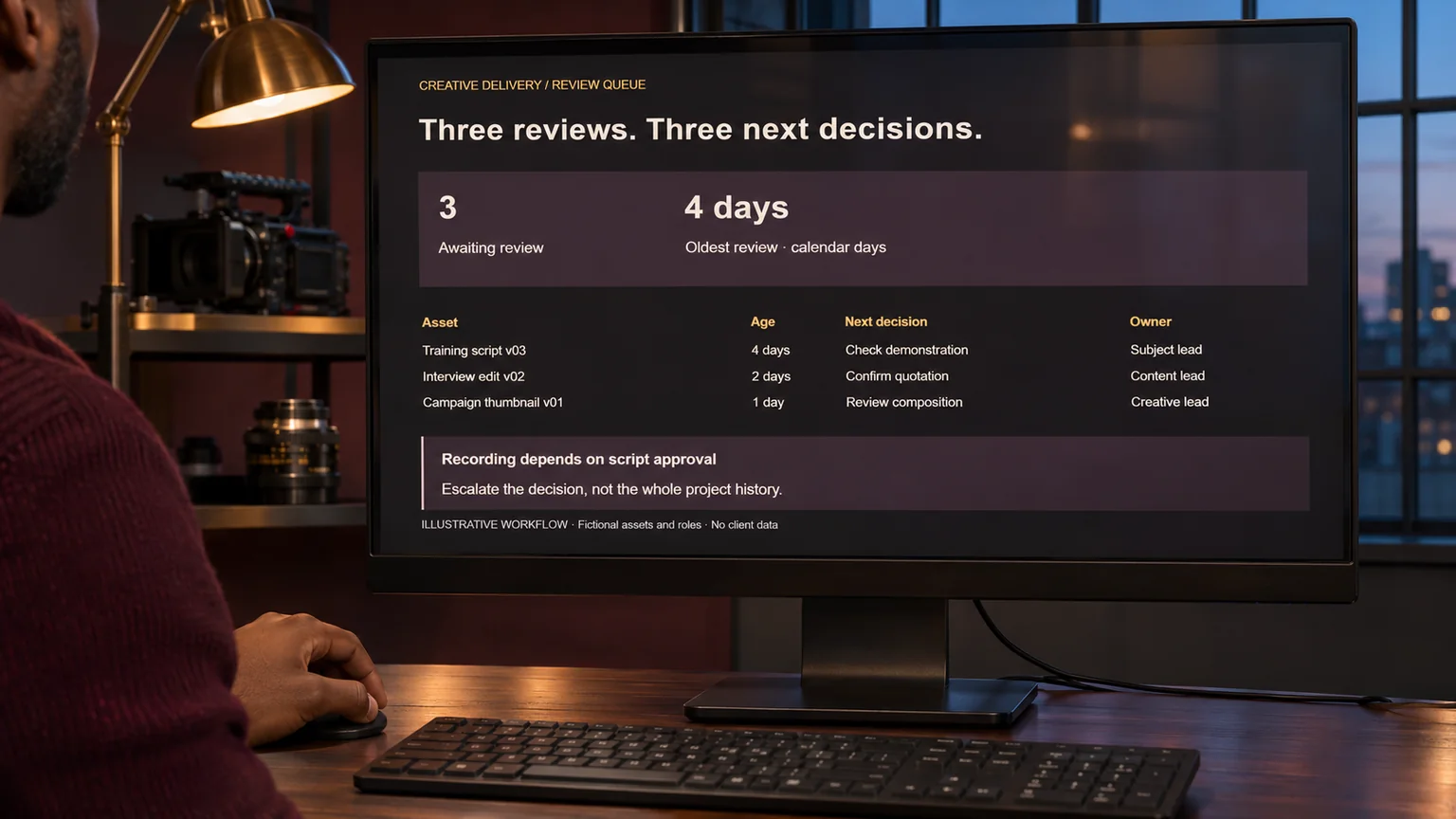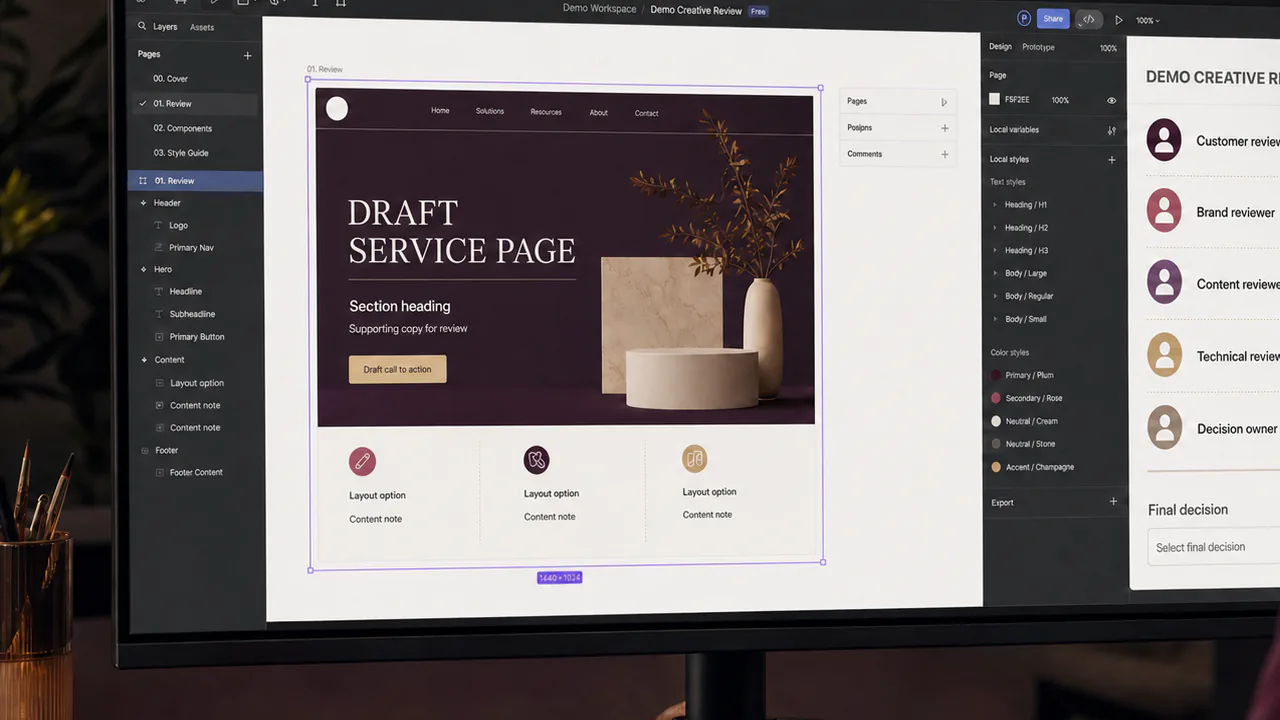

An approval message can be reassuring and still leave the production team with an unanswered question: approved for what? I would want to know which file was reviewed, which version it was and what use the reviewer intended to accept.
Imagine a fictional education campaign with a full lesson video, a short promotional extract and a translated caption file. The lesson owner approves the full video for an internal pilot. I would not automatically treat that decision as permission to publish every derivative publicly.
I identify the review object
My review request would link to one identifiable version. I would include its filename or stable asset identifier, version and relevant date in the private project record. The reviewer should not have to infer whether a message refers to yesterday's cut or a newly uploaded replacement.

If the review tool allows a version to be replaced, I would confirm how the decision remains associated with the actual reviewed material. Convenience should not make the evidence ambiguous. A clear archive link can be more useful than a shared folder containing several similarly named exports.
I state the acceptance question
I would distinguish content accuracy, presentation quality, technical delivery and release permission. The same person may hold more than one responsibility, but I would still make the requested decision explicit.

For the fictional lesson, the question might be whether the explanation is suitable for the internal pilot. That does not necessarily answer whether the promotional extract retains enough context. I would give that extract its own bounded review question instead of relying on the broader video's approval.
I preserve qualifications
A response such as approved once the title is corrected contains both a decision and an outstanding condition. I would record the condition, assign its owner and verify the resulting version before treating the release item as ready.
I would not rewrite a qualified response as an unconditional approval in a dashboard. The dashboard can summarise status, but its meaning must remain connected to the underlying record. If the wording is unclear, I would ask a specific follow-up rather than choose the most convenient interpretation.

I check usage permissions separately
Acceptance of an edit does not establish that every photograph, music track or other asset has the necessary usage permission. I would keep those records distinct and ensure the release owner can see unresolved restrictions.
Creative Commons explains that its licences carry different permissions and conditions. That is one reason I would record the actual licence or permission, rather than use a generic free-to-use label. Creative Commons licence overview. It does not establish permission for the fictional campaign's assets.
I connect the decision to the release manifest

My release manifest would list the accepted files and intended destinations. If the pilot video is internal-only, that scope would remain visible beside its release status. A public promotional extract would appear as a separate item with its own acceptance evidence.
I would also verify the file at the destination after release. Uploading the right version is an action; checking that the destination serves it is a separate observation. Both help the next person understand what the audience can actually access.
I keep later changes visible

If a title, translation or sequence changes after approval, I would assess whether the change affects the accepted meaning or scope. The appropriate reviewer should decide whether another review is required. I would not assume that a small production change is automatically immaterial.
For me, a useful approval record is precise enough to guide action. It tells the team what they may release, what remains conditional and where to find the evidence. That is more dependable than a green label whose meaning changes depending on who reads it.
Research and example note
Prepared for 12 November 2026. The campaign and decisions are fictional. The Creative Commons source supplies general licence context only. This article does not determine legal rights or replace the responsible owner's review of actual permissions.